Home › Products › Tissue Embedding Station
Tissue Embedding Station
Good sections begin with well-oriented blocks.
Orientation, warmth and throughput — embedding built for a busy grossing bench.
Good sections begin with well-oriented blocks.
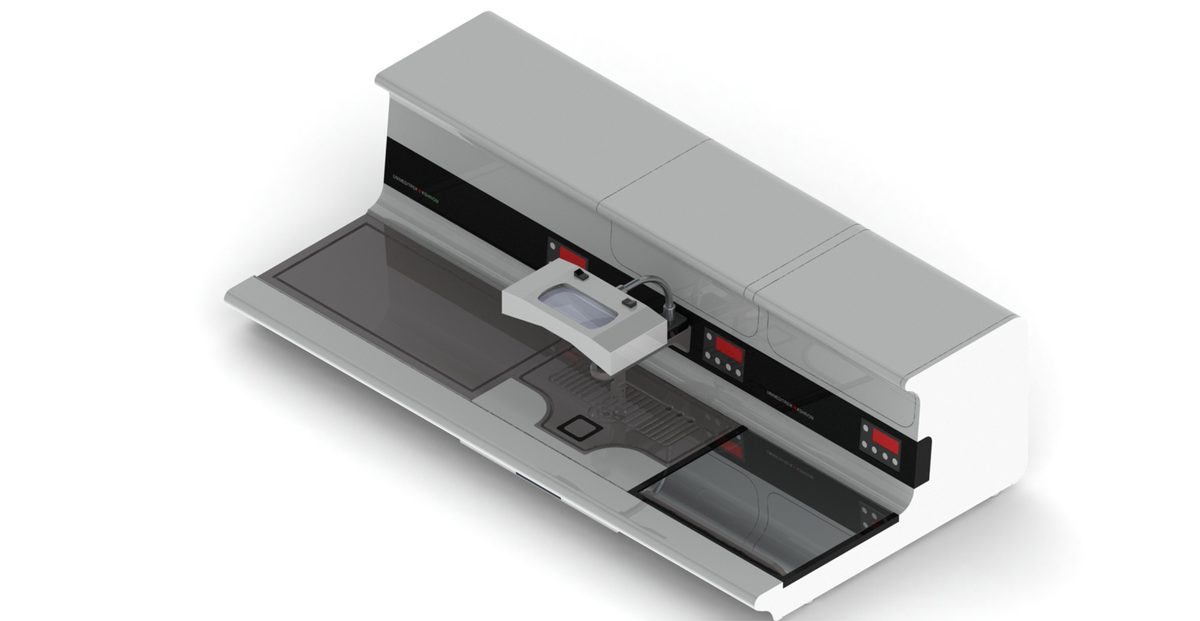
The TES-500 gives technicians a fast, comfortable workspace with steady wax flow and firm cooling — so blocks are well-oriented and cut cleanly downstream.
Talk to a histopathology specialistEverything the tissue embedding station needs, in one workstation
Each zone is tuned for its job — so a technician moves smoothly from processed cassette to a firm, clean-cutting paraffin block.
Heated paraffin reservoir
Keeps paraffin in molten form, ready for smooth embedding throughout the working session.
Wax dispenser
Controlled dispensing of molten wax into moulds for clean, bubble-free paraffin blocks.
Heated work area
Prevents premature wax solidification while the technician orients the tissue correctly.
Cassette & mould warming area
Keeps cassettes and moulds warm and ready for an uninterrupted embedding workflow.
Cold plate
Rapidly cools embedded blocks so they set firm and are ready for trimming and microtomy.
What is a tissue embedding station?
A tissue embedding station combines a heated paraffin reservoir, a heated working area (and heated forceps well), a dispensing nozzle and a fast cold plate. The technician transfers processed cassettes, orients the tissue in a mould, dispenses wax and moves the mould to the cold plate to set.
Tissue Embedding Station
The block you embed decides the section you cut. The TES-500 brings a heated paraffin reservoir, a fast cold plate and a holding tank together in one ergonomic station — so your team orients tissue correctly and sets firm, clean-cutting blocks quickly and comfortably, all day long.
Key features
- Heated reservoir & cold plate
- Correct orientation
- Ergonomic workflow
- Clean-sectioning blocks
Get a tailored offer
Supply, installation, training and AMC across India — reply within one working day.
Inside the Tissue Embedding Station
Explore the machine — tap any component to see what it does and why it matters.
Select any component on the left to learn what it does and why it matters to your results.
Key benefits
Correct orientation, interpretable margins
A bright, roomy work surface and steady heated reservoir make precise orientation easy — so laterality and margins stay readable downstream.
Firmer blocks, cleaner sections
A fast, even cold plate sets blocks solid for chatter-free microtomy and fewer recuts.
Ergonomic comfort, all day
A thoughtfully laid-out hot/cold workspace reduces reach and strain during high-volume embedding.
Throughput without compromise
Heated reservoir, cold plate and holding tank keep the line moving when the cassette load is heavy.
Reliable and low-maintenance
Simple wax-path cleaning and stable plate temperatures keep it dependable shift after shift.
Specifications
Dispenser unit TES 500 (I)
| Paraffin tank | 3.5 / 5 litres with filters |
| Total dimensions (W×D×H) | 360 × 630 × 330 mm |
| Working plate / temperature | 365 × 255 mm · +30°C to +70°C |
| Cold spot | -5°C, 40 mm Ø |
| Forceps | 2 heated-forceps connections (EBP 50); wells for 6 |
| Timer | 7-day programmable |
| Weight / power | 22 kg · 115–230 V / 50–60 Hz / 350 VA |
| Optional | Cold-light lamp · 4-diopter magnifier |
Thermal unit TES 500 (II)
| Warming chamber / tray | 310 × 210 mm · 300 × 240 mm |
| Temperatures | Chamber +30–70°C · tray +30–75°C |
| Weight / power | 15 kg · 115–230 V / 50–60 Hz / 750 VA |
Cooling unit TES 500 (III)
| Cold plate | Stainless steel 505 × 265 mm · ~110 blocks (CFC-free) |
| Temperature | +15°C down to -15°C |
| Weight / power | 25 kg · 115–230 V / 50–60 Hz / 320 VA |
Technical specifications subject to change. Wide range of accessories on request.
Full lab guide, technician notes & tender specification
What this instrument does — and why it matters in your lab
The block you embed sets the ceiling on the section you cut. Poor cold-plate performance, cramped consoles or messy dispensing lead to soft blocks, wrong orientation and recuts — which cost far more time downstream than the station ever saved. A good embedding station lets the team orient tissue correctly and set firm, clean-cutting blocks, comfortably, all day.
A tissue embedding station combines a heated paraffin reservoir, a heated working area (and heated forceps well), a dispensing nozzle and a fast cold plate. The technician transfers processed cassettes, orients the tissue in a mould, dispenses wax and moves the mould to the cold plate to set. Correct orientation and firm setting here are what make micron-thin, representative sections possible at microtomy.
Suitable for hospitals, medical colleges & diagnostic labs
Used by hospital and medical-college histopathology labs and diagnostic centres. A department with two or three people embedding at peak needs enough dispensing and cold consoles to avoid a bottleneck. Purchase teams ask for reservoir capacity, cold-plate performance, number of consoles, power and AMC/CMC; the pathology department checks ergonomics and orientation support before approval.
Practical points before you buy and install
Common questions before buying
- Paraffin reservoir capacity for your embedding volume.
- Cold-plate speed and low temperature — the single biggest factor in firm, recut-free blocks.
- Number of dispensing/cold consoles for your team at peak.
- Dispensing control (hand/foot, adjustable flow) and a heated forceps well.
- Ergonomics and heated work surface for all-day use, plus service and spares.
Practical points before installation
- Confirm the electrical point and stable bench.
- Plan the layout so embedding sits between processing and microtomy in the workflow.
- Keep paraffin and moulds ready for the first session.
What usually goes wrong in labs
- Soft or crumbly blocks and recuts — an undersized or slow cold plate, or wax/temperature issues.
- Wrong orientation — cramped working area or rushed embedding; the diagnostic plane is then lost.
- Messy, uneven blocks — poor dispensing control.
- Technician fatigue — poor ergonomics and heated-surface layout on a heavy embedding day.
Maintenance points
- Keep the reservoir and dispensing nozzle clean to prevent wax build-up and drips.
- Check and record per-zone temperatures.
- Maintain cold-plate performance and defrost as required.
- Keep a maintenance log for audit.
Documents supplied with installation
- PDI checklist
- Installation checklist and site-readiness note
- Operating manual
- Final QC checklist
- Warranty certificate and AMC/CMC terms
- Service report format
Operator training points
- Correct tissue orientation for common specimens (GI, skin, tubular, multiple small biopsies)
- Dispensing and mould handling
- Using the cold plate for firm setting
- Cleaning and temperature checks
AMC / CMC considerations
AMC/CMC covers preventive maintenance of the heating zones, cold plate and dispensing, temperature checks and priority response.
Technician & biomedical notes
Technician notes
- Orient tubular and skin specimens correctly — a wrong plane cannot be recovered downstream.
- Do not rush setting on a slow/overloaded cold plate; soft blocks cause recuts.
- Keep the dispensing nozzle clean to avoid drips and uneven blocks.
- Report temperature drift early — it shows up as poor sections.
Biomedical / maintenance notes
- Provide the rated electrical point and a stable bench.
- Verify cold-plate performance and heated zones at installation.
- Hold PDI/installation/QC checklists and AMC service reports.
- Plan spares and consumable service parts.
Buying for a hospital or medical college?
Unimeditrek can provide the product brochure, compliance/deviation statement, technical specification sheet, budgetary quotation, warranty terms, installation & site-readiness requirements and AMC/CMC details for hospital and medical-college procurement — including government tenders.
Upload TenderRequest Compliance SheetRequest Budgetary QuoteRequest Technical Specification
Supplied with every installation
Product close-up images
Available on request
Product testing video
Available on request
PDI checklist sample
Available on request
Installation checklist
Available on request
Final QC checklist
Available on request
Service report format
Available on request
Warranty / AMC format
Warranty certificate and AMC/CMC terms supplied at installation.
Tender compliance format
Compliance/deviation statement prepared per tender specification.
This page has been prepared and reviewed by the Unimeditrek technical team based on histopathology equipment workflow, installation requirements, service experience and common buyer questions from hospitals, medical colleges and diagnostic laboratories.
Recommended consumables for this equipment
Keep your Tissue Embedding Station running with matched, lab-grade consumables — order on demand or subscribe for automatic monthly supply. Online checkout & payment launching soon.

 Tissue processing
Tissue Cassettes
Biopsy & standard cassettes for processing and embedding.

Kits & packs for this machine
Starter Kit
6 items · Paraffin Wax, Embedding Moulds, Tissue Cassettes, Embedding Forceps…
EnquireMonthly Consumables Pack
4 items · Paraffin Wax, Embedding Moulds, Tissue Cassettes, Heating Surface Cleaner
EnquireAnnual Consumables Pack
4 items · Paraffin Wax, Embedding Moulds, Tissue Cassettes, Heating Surface Cleaner
EnquireDownloads & documents
Why it matters to your role — pathologist, technician, procurement & biomedical
Why it matters to you
Built to serve every stakeholder in the lab.
- Consistent, reproducible results that protect diagnostic quality
- Clean output that reduces repeats and rework
- Designed around the real histopathology workflow
Manual vs automatic — what changes
Conventional equipment vs the Tissue Embedding Station
How the Tissue Embedding Station compares with typical conventional equipment on the points that affect quality, safety and uptime.
| Feature | Conventional equipment | Unimeditrek |
|---|---|---|
| Heated & cold zones | Often separate units | Integrated station |
| Orientation & flat blocks | Basic | Ergonomic, efficient |
| Throughput | Slower | Continuous-flow layout |
| Service & AMC | Variable | AMC/CMC + genuine spares |
Comparison is against typical conventional equipment in this category and is provided for general guidance.
How it compares across the range
How it compares across the range
A quick side-by-side of Tissue Embedding Station and related equipment. Open any product for full specifications.
| Feature | Tissue Embedding StationThis product | Automatic Vacuum Tissue Processor | Automatic Slide Staining Machine | Cryostat Microtome |
|---|---|---|---|---|
| Workflow stage | Histopathology | Tissue Processing | Histopathology | Histopathology |
| Category | Histopathology | Histopathology | Histopathology | Histopathology |
| Made in India | ✓ | ✓ | ✓ | ✓ |
| Installation & training | Included | Included | Included | Included |
| Warranty | Standard | Standard | Standard | Standard |
| AMC / CMC | Available | Available | Available | Available |
| Genuine spares | ✓ | ✓ | ✓ | ✓ |
| Details | You are here | View → | View → | View → |
Buyer's guide — how to compare & what to check before you buy
How to compare the Tissue Embedding Station before you buy
Specifications alone don't tell the whole story. Use this checklist to evaluate any histopathology instrument objectively — and ask every vendor, including us, the same questions.
On the machine
- Working surface size and bench ergonomics
- Separate heated and cold areas, and warm-up time
- Wax reservoir capacity and flow control
- Orientation aids and operator comfort
- Cleaning effort and daily maintenance
On the vendor & support
- Manufacturer track record and Make-in-India status
- Nationwide installation, training and service coverage
- Genuine spare-parts availability and stocking in India
- Warranty terms and AMC/CMC options
- Compliance sheets and tender documentation (ISO 13485, CE, CDSCO)
- Reference installations you can actually call
Institutions across India that chose Unimeditrek
The Tissue Embedding Station comes from the same manufacturer trusted by government hospitals, medical colleges and research institutes nationwide. A representative selection of institutions we have supplied and continue to support:
A representative selection from 500+ installations across India. See installations & proof → · Request customer references →
Installation & site requirements
A detailed pre-installation / site-readiness document — power, space, environment and connectivity — is provided with your quotation. Our engineer confirms readiness before installation.
Power supply
Stable supply; stabiliser/UPS where recommended.
Space & bench
Bench or floor space with clearance for service access.
Environment
Controlled temperature/humidity and ventilation as specified.
Utilities
Water/drainage or exhaust where the instrument requires it.
Installation, training & AMC/CMC detail
Professional installation and commissioning, operator training, preventive maintenance, calibration support, genuine spare parts and warranty management — backed across India. Service & AMC/CMC →
Commercial & tender readiness
We sell on quotation, not a fixed list price — so you get a configuration that matches your workload and budget, with the documentation government and institutional buyers need. Here is exactly what a purchase includes and how we support procurement.
What's included
Supply, professional installation & commissioning, operator training, standard warranty and handover documentation — quoted transparently, no hidden add-ons.
Total cost of ownership
Energy- and reagent-efficient operation, affordable AMC/CMC, genuine spares stocked in India and high uptime — lower lifetime cost than a low-quote import.
Tender & procurement pack
Editable technical specification, Make-in-India declaration, ISO 13485 & compliance sheets, warranty/AMC formats and a ready BOQ line — for GeM and institutional tenders.
Flexible commercials
Configuration-specific quotation usually within one working day, AMC/CMC options, and institutional / multi-unit pricing on request.
Request a commercial proposal Request the tender pack Tender support →
Book a demonstration
Don't buy on a brochure alone. See the Tissue Embedding Station working and ask your technical questions directly to our specialists.
Live online demo
A scheduled screen-share / video walkthrough with a product specialist — anywhere in India, no travel needed.
On-site demonstration
Where feasible we arrange a demonstration at your lab or a nearby reference site so your team can see it in person.
WhatsApp walkthrough
Prefer something quick? Ask on WhatsApp and we'll send a short walkthrough and answer your questions.
Guides, use cases & white papers
Complete Guide to Histopathology
A complete guide to histopathology — what it is, the laboratory workflow from grossing to reporting, the equipment involved, staining, quality and digital pathology.
Read the guide →Complete guideComplete Guide to Tissue Processors
A complete guide to tissue processors — the science of fixation, dehydration, clearing and paraffin infiltration, vacuum technology, throughput, troubleshooting and how to select one.
Read the guide → Use casesTissue Embedding Station — four scenarios
How it is used across diagnostic labs, medical colleges, oncology centres and government institutions.
Read document → White paperPlanning and Setting Up a New Histopathology Laboratory
A workflow-first framework for equipping a histopathology laboratory — from case-load planning and layout to utilities, equipment selection, commissioning and support.
Read document →Is the Tissue Embedding Station right for your lab?
Before you buy, ask these questions
- What is your daily block volume?
- Do you need separate hot, cold and holding zones?
- How many heated-forceps positions do you need?
- Is the cold plate fast enough for your throughput?
- Is the workspace ergonomic for long sessions?
- What are the power and bench requirements?
- What training and AMC are offered?
Get a configuration recommendation Upload tender for compliance support
Reviews — Tissue Embedding Station
★★★★★ 5.0 out of 5 · based on 3 verified customer reviews
“We have two tissue embeding stations , one is unimeditrek which never troubled us till date another one belonging to other company which never left us out of trouble.”
“We have two tissue embeding stations , one is unimeditrek which never troubled us till date another one belonging to other company which never left us out of trouble.”
“The Tissue Embedding Station from Unimeditrek has been a game-changer for our lab. Its reliability and consistent performance have significantly improved our workflow and sample quality. I trust it completely for embedding, making my job much easier.”
Common questions
What is the wax reservoir capacity?
The TES-500 dispenser unit has a heated paraffin tank of 3.5–5 litres (with filters), thermostatically controlled from +30°C to +70°C.
Does it include a cold plate?
Yes — the TES-500 cooling unit has a stainless-steel cold plate (500 × 260 mm, space for about 110 blocks) reaching down to −15°C (range +15°C to −15°C, CFC-free) for fast, firm setting.
Is heated forceps support available?
Yes — the TES-500 dispenser unit has heated forceps wells (three forceps each side of the dispensing nozzle) with connections for heated forceps.
How does embedding affect sectioning quality?
Directly — correct orientation and firm setting at embedding are what allow micron-thin, representative sections. Poor embedding causes recuts and lost diagnostic planes at microtomy.
How many consoles do I need?
The TES-500 is a 3-part modular system — a dispenser unit, a thermal (warming) unit and a cooling unit — that can be combined or placed separately. Match dispensing and cold consoles to your team at peak so embedding is not a bottleneck.
What should be checked before installation?
A stable bench, the rated electrical point, and workflow placement between processing and microtomy. Keep paraffin and moulds ready.
What cleaning is required?
Keep the reservoir and dispensing nozzle free of wax build-up, check temperatures and maintain the cold plate. We provide the routine and a maintenance log.
Is training provided?
Yes — installation includes training on orientation, dispensing, cold-plate use and cleaning.
Is AMC/CMC available?
Yes — AMC and comprehensive CMC with scheduled preventive maintenance.
Can this be supplied for a government tender?
Yes. We provide Product brochure, technical specification sheet, compliance/deviation statement, budgetary quotation, warranty terms, installation & site-readiness requirements and AMC/CMC details.
Is the tissue embedding station the same as a tissue embedder or histo embedder?
Yes — “tissue embedder”, “histo embedder” and “tissue embedding machine” all refer to the paraffin embedding station. Ours combines a heated paraffin reservoir, cold plate and tissue holding tank in one ergonomic unit for fast, correctly oriented blocks.
What is the price of the Tissue Embedding Station in India?
The price depends on capacity/configuration, accessories, installation location, warranty, AMC/CMC requirement, tender documentation and GST/freight. Share your requirement — such as cassette load or daily throughput — and we’ll send a configuration-specific quotation, usually within one working day.
Is the Tissue Embedding Station made in India?
Yes — Unimeditrek Pvt. Ltd. manufactures it in India, with nationwide installation, training and service support.
Do you provide installation, training and AMC/CMC?
Yes — professional installation and commissioning, operator training, preventive maintenance and AMC/CMC contracts are available across India.
Can you provide technical specifications and compliance documents?
Yes — technical specifications, compliance sheets, warranty/AMC formats and Make-in-India declarations are available on request from our team.
Is the Tissue Embedding Station available for export?
Yes — we supply international distributors. Contact us for export documentation and distributor terms.
Author: Unimeditrek Technical Content Team · Reviewed by: Unimeditrek Biomedical Engineering & Histopathology Applications team · Last reviewed: July 2026.
Educational and procurement guidance for histopathology laboratories. Configurations and specifications are confirmed against your requirement at the time of quotation; regulatory certificates and registration documents are issued on request per product and destination.
Ready to move forward?
Request a Quote Talk to a specialist Add to Lab Plan Become a Dealer
Related: Tissue Embedding Station Tender Specification → How to Choose a Tissue Embedding Station → Paraffin Embedding Station → Histo Embedder → Embedding Station Consumables → Tissue Embedding Station AMC & Service → Embedding Errors and How to Reduce Recuts →