What embedding is
After tissue processing has replaced the water in the tissue with paraffin, each piece must be embedded: placed into a metal mould, correctly oriented, and surrounded by molten wax that is then set solid over a cold spot to form the block from which sections are cut. The block must hold the tissue firmly and in the right plane so the microtome can shave representative sections. Embedding therefore directly governs how much diagnostic tissue the pathologist ultimately sees.
Why orientation is critical
Different specimens must face the blade in a specific plane:
- Tubular structures (e.g. vas, fallopian tube, GI biopsies) are oriented to give a cross-section through the wall and lumen.
- Skin is embedded on edge so the section runs through all the layers from epidermis to deep margin.
- Multiple small biopsies are laid flat and at the same level so all appear on one section.
Get this wrong and the section misses the diagnostic feature; there is no downstream step that can recover it. Orientation is the skill embedding equipment exists to support.
Components of an embedding station
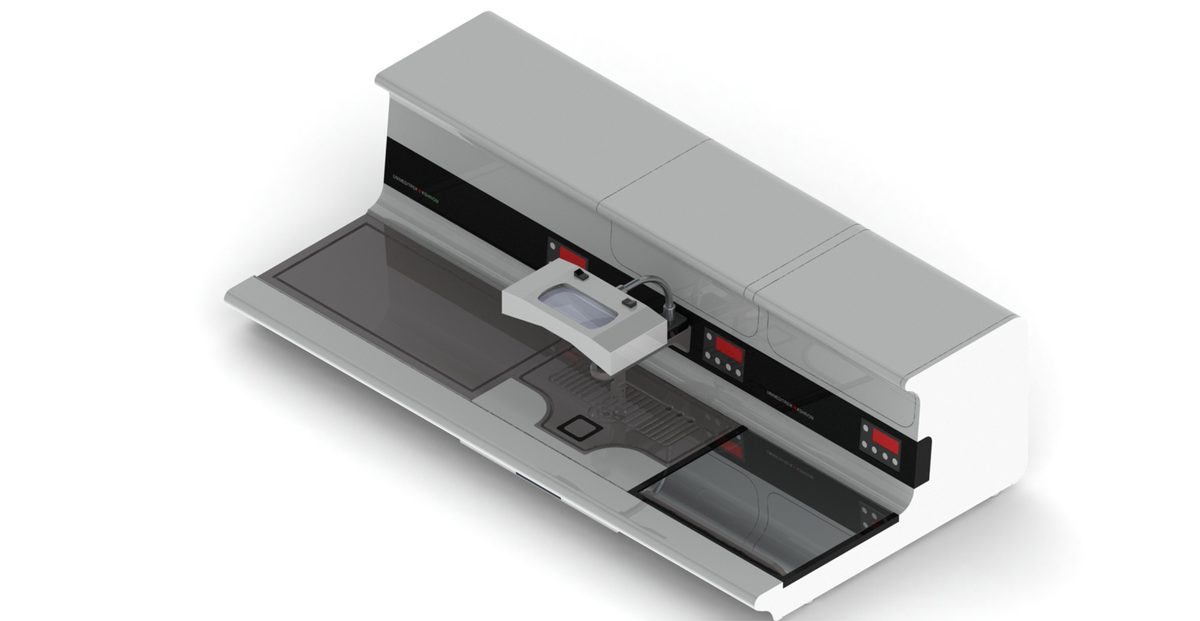
A modern embedding centre usually combines, in one or two modules:
- A heated paraffin reservoir with a controlled dispenser tap for a clean flow of molten wax.
- A heated working surface and warm forceps wells so wax does not set prematurely while you orient.
- A cold plate / cryo spot that rapidly sets the block once oriented.
- A warm holding area for cassettes waiting to be embedded.
- Mould storage and good task lighting and magnification.
The two thermal zones — hot to keep wax flowing while you orient, cold to lock the block — are the essence of the design.
Features that matter
- Accurate, independent temperature control of reservoir, dispenser and working surface.
- A reliable, drip-free paraffin dispenser with adjustable flow.
- A fast, cold cold-plate with enough capacity for your throughput.
- Ergonomics — heated forceps wells, comfortable hand and foot positions, good light and magnification for long sessions.
- Throughput — warm holding capacity and layout matched to your block volume.
- Easy cleaning and paraffin management.
Ergonomics and throughput
Embedding is repetitive, fiddly work done for long stretches, so ergonomics are not a luxury — they protect both speed and accuracy. A well-laid-out station keeps molten wax, warm forceps, cassettes and moulds within easy reach, with the cold plate positioned for a natural place-orient-set rhythm. Good lighting and magnification reduce orientation errors on tiny biopsies. Comfortable, efficient embedding directly raises both block quality and the number of blocks a technologist can embed well per hour.
Common embedding problems
- Wrong orientation — the most costly fault; the section misses the diagnostic plane. Slow down on tubular and skin specimens and use magnification.
- Air bubbles / gaps in the block — wax too cool when poured, or trapped air; keep the reservoir at temperature and pour smoothly.
- Tissue moves while setting — block set too slowly; press tissue to the mould base on the cold spot before topping up.
- Cracked or crumbly blocks — wax too cold, contaminated, or over-rapid cooling; check paraffin condition and temperatures.
- Tissue not flat / not at one level — re-orient on the warm surface before final setting.
Embedding sits between processing and microtomy; a well-embedded block makes clean sectioning far easier.
Frequently asked questions
Why is orientation so important in embedding?
Because the plane in which tissue is set determines what the microtome can cut. A tubular structure embedded on its side, or skin embedded flat instead of on edge, will not yield a representative section — and no later step can recover the missed diagnostic feature.
What are the main parts of a tissue embedding station?
A heated paraffin reservoir with a dispenser, a heated working surface and warm forceps wells to keep wax flowing while you orient, a cold plate to set the block quickly, a warm holding area for cassettes, and good lighting and magnification.
What causes air bubbles or gaps in a paraffin block?
Usually paraffin that is too cool when poured, or air trapped under the tissue. Keeping the reservoir at the correct temperature, pressing the tissue to the mould base and pouring smoothly prevents most bubbles.
Why do my blocks crack or crumble?
Common causes are wax that is too cold or contaminated, or cooling that is too rapid. Check the condition and temperature of the paraffin and avoid over-rapid cooling of the finished block.
Prepared and reviewed by the Unimeditrek technical team based on laboratory practice, installation and service experience. This document explains histopathology workflow, laboratory practice and equipment based on the questions we hear from hospitals, medical colleges and diagnostic laboratories — vendor-neutral where it explains the science and practical where it explains equipment.