Building a Reliable Intra-operative Frozen Section Service
How to deliver fast, dependable frozen-section diagnoses for the operating theatre — chamber set-up, workflow, staining, safety and continuity.
Abstract
Intra-operative frozen section gives the surgeon a provisional diagnosis within minutes, guiding decisions such as the adequacy of margins or whether to proceed with a wider resection — while the patient is still under anaesthesia. It is one of the most time-critical and unforgiving tasks in pathology. This paper outlines how to build a frozen-section service that is fast, consistent and safe under pressure, covering cryostat set-up, the rapid workflow, staining, safety and service continuity.
What frozen section demands
Frozen section compresses the entire histopathology workflow into minutes: fresh tissue is frozen, sectioned, stained and read while theatre waits. There is no margin for chamber instability, blunt blades, poor sections or staining delay, because every minute is a minute the patient is under anaesthesia. A dependable service therefore depends as much on disciplined workflow and equipment reliability as on interpretation.
Why a dependable service is worth building
A reliable frozen-section service expands the range of procedures a hospital can offer, supports margin-guided cancer surgery, and builds surgeon confidence in the pathology team. An unreliable one does the opposite — surgeons stop trusting it, and the capability atrophies.
Cryostat set-up and the rapid workflow
- Chamber temperature: set and verify it for the tissue type — typically around −15 to −25 °C, colder for fatty tissue — and let it stabilise before the case.
- Freezing and sectioning: freeze the specimen on the chuck, use a sharp blade and a correctly-set anti-roll plate for flat, readable sections.
- Rapid staining at the bench: keep a rapid staining set-up ready beside the cryostat so sections are read without leaving the room.
- Standardise and rehearse: a written protocol and trained team make the difference under pressure.
Safety with fresh, unfixed tissue
Frozen section handles fresh, potentially infectious tissue. Strict cleaning and disinfection of the chamber and surfaces between cases, scheduled defrost cycles, and clear safety protocols are essential — both for staff and to prevent cross-contamination between patients.
Protecting continuity
Because the service is called at short notice and cannot fail mid-case, the cryostat must be kept theatre-ready: preventive maintenance, temperature verification, blade and anti-roll upkeep, and assured spares. A service contract that guarantees response is part of the clinical capability, not an optional extra.
How Unimeditrek helps
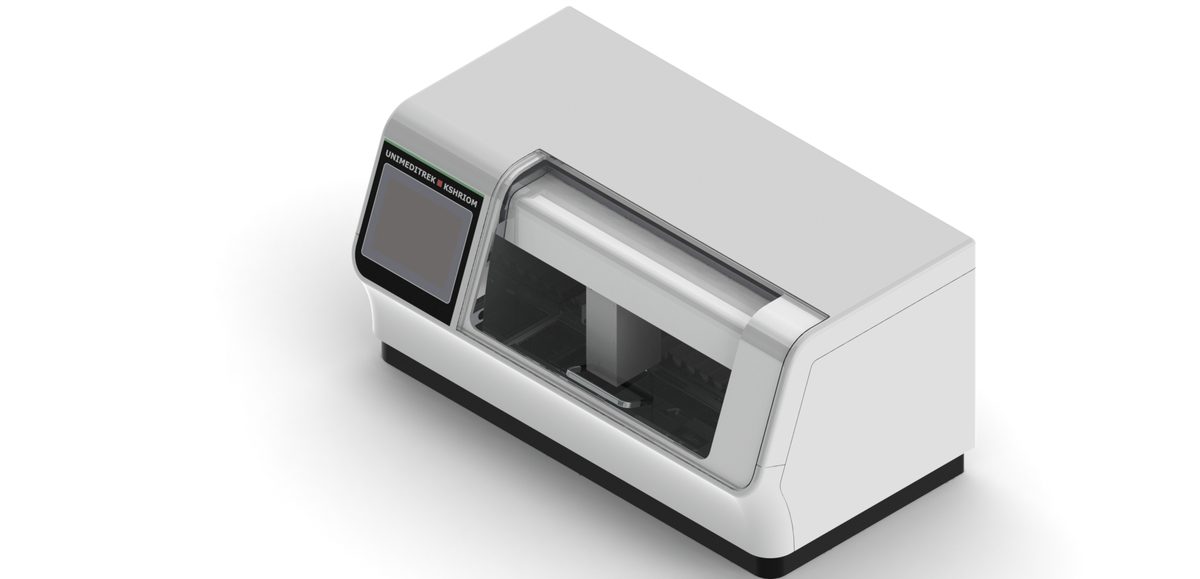
Our cryostat microtome is built for rapid, repeatable frozen sectioning with stable chamber control and an effective anti-roll system, and pairs with rapid staining for a complete bench workflow. Our service team keeps it operating-theatre-ready through AMC/CMC, temperature verification and genuine spares. See the cryostat microtome or Service & AMC/CMC.
Frequently asked questions
What makes a frozen-section service reliable?
A cryostat that holds chamber temperature stably, a well-set anti-roll plate, a rehearsed bench workflow with rapid staining, strict safety/disinfection, and — critically — service cover so the instrument is never down during a surgical list.
What chamber temperature is used?
It is set for the tissue type and the pathologist’s preference within the cryostat’s range; fatty tissue needs colder settings. Stable temperature matters more than any single number.
Why is service response so critical for a cryostat?
Because it is used intra-operatively — the surgeon is waiting. Downtime delays a live case, so we recommend AMC/CMC with priority response, temperature verification and spares kept planned.
How are safety and disinfection handled between cases?
Through a defined defrost, cleaning and disinfection routine with careful blade handling. This is supplied with installation and covered in training.
What causes rolled or torn frozen sections?
Usually the anti-roll plate not being set correctly or the temperature not matching the tissue. Both are covered in operator training and are quick to correct.
How quickly can a frozen section be reported?
A well-run service typically delivers an intra-operative answer in minutes once the chamber is pre-cooled and the workflow is rehearsed — pre-cooling before the list is key.
What staining is used for frozen sections?
A rapid stain at the bench so the pathologist can read while the patient is still in theatre; the cryostat pairs with a rapid staining setup for a complete workflow.
What maintenance does a cryostat need?
Scheduled defrost and chamber cleaning, disinfection between cases, temperature checks and periodic preventive maintenance of the refrigeration and microtome mechanism — best covered under AMC/CMC.
Prepared and reviewed by the Unimeditrek technical team based on laboratory practice, installation and service experience. This document explains histopathology workflow, laboratory practice and equipment based on the questions we hear from hospitals, medical colleges and diagnostic laboratories — vendor-neutral where it explains the science and practical where it explains equipment.
Discuss this for your laboratory
Our specialists can map this to your case load and recommend the right configuration, documentation and service plan.