Slide Warming Table — Use Cases
Four detailed, real-world scenarios — high-volume diagnostic laboratory, medical college, oncology, government hospital and more — showing how the Slide Warming Table is applied end to end.
🔬 High-volume diagnostic laboratory
Setting & background
A private or hospital diagnostic laboratory running a large daily case load of biopsies and resections, where the histopathology report drives clinical decisions and where turnaround time (receipt-to-report) is tracked as a core performance indicator. Work moves in batches across grossing, processing, embedding, microtomy, staining and reporting, and the department is judged on both speed and consistency.
The challenge
What this laboratory needs
- Reproducible output that does not depend on the individual operator
- Throughput that scales with rising case volume without overnight bottlenecks
- Low recut and re-processing rates to protect turnaround time
- High uptime with a fast service response when something fails
- Audit-ready records and SOPs for NABL / accreditation
How the Slide Warming Table addresses it
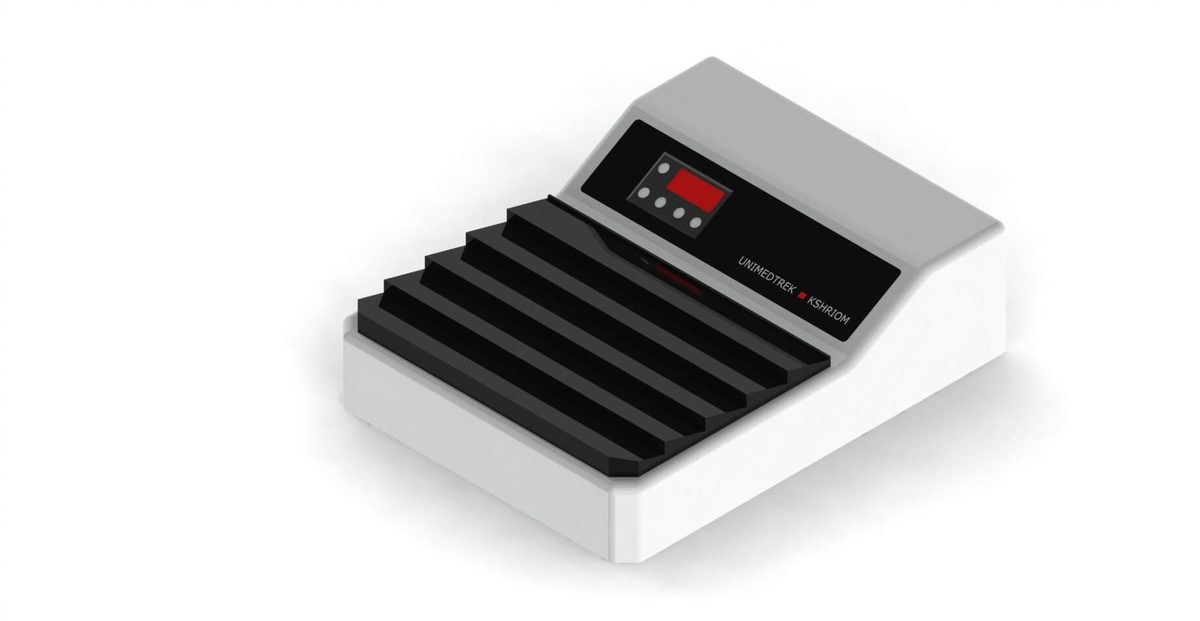
Freshly mounted slides are warmed on a flat, thermostatically-controlled surface to drain residual water and bond the section to the glass. Even, controlled heat is what prevents the section loss and drying artefacts that come from uneven surfaces or excessive temperature — protecting all the work done upstream.
Capabilities that matter in this setting:
- Even, thermostatically-controlled heating surface
- Large capacity for batch drying
- Stable low-temperature operation
Workflow & configuration
In the histopathology workflow it sits between floatation & mounting upstream and staining downstream — so its performance affects, and is affected by, the steps on either side.
Practical considerations:
- Held at a gentle, controlled temperature for adhesion without artefact
- A uniform surface temperature avoids hot spots that cook sections
Consumables, maintenance & support
Matched consumables: glass slides.
Preventive maintenance (under AMC/CMC): surface-temperature calibration; routine cleaning. Each unit carries a per-instrument service record, with genuine spares and pan-India support across its operating life.
Outcome & metrics to monitor
Expected benefits: even, gentle drying, better section adhesion, protection against drying artefacts and section loss.
Track these to verify the impact:
- Turnaround time — median and 90th percentile, receipt to authorised report
- Recut / re-processing rate per 100 blocks
- Slide rejection / re-stain rate
- Instrument uptime and mean time to repair
🎓 Medical college & teaching laboratory
Setting & background
A medical college or teaching-hospital histopathology department that trains undergraduates, postgraduates and residents alongside a real service workload, on equipment shared by many hands every day. Teaching sets must be consistent enough to learn morphology from, and instruments must be safe and simple enough for supervised trainees to operate.
The challenge
What this laboratory needs
- Reproducible, textbook-quality preparations for teaching sets
- Simple, safe operation appropriate for supervised trainees
- Robust build that tolerates heavy, shared daily use
- Clear SOPs and documentation to teach standard technique
- Dependable service, training and spares from the manufacturer
How the Slide Warming Table addresses it
Freshly mounted slides are warmed on a flat, thermostatically-controlled surface to drain residual water and bond the section to the glass. Even, controlled heat is what prevents the section loss and drying artefacts that come from uneven surfaces or excessive temperature — protecting all the work done upstream.
Capabilities that matter in this setting:
- Even, thermostatically-controlled heating surface
- Large capacity for batch drying
- Stable low-temperature operation
Workflow & configuration
In the histopathology workflow it sits between floatation & mounting upstream and staining downstream — so its performance affects, and is affected by, the steps on either side.
Practical considerations:
- Held at a gentle, controlled temperature for adhesion without artefact
- A uniform surface temperature avoids hot spots that cook sections
Consumables, maintenance & support
Matched consumables: glass slides.
Preventive maintenance (under AMC/CMC): surface-temperature calibration; routine cleaning. Each unit carries a per-instrument service record, with genuine spares and pan-India support across its operating life.
Outcome & metrics to monitor
Expected benefits: even, gentle drying, better section adhesion, protection against drying artefacts and section loss.
Track these to verify the impact:
- Consistency of teaching-set slides across batches
- Trainee re-do / error rate on routine preparations
- Equipment availability during scheduled teaching hours
🎗️ Oncology & cancer-care centre
Setting & background
An oncology centre or cancer hospital where histopathology underpins diagnosis, tumour grading and treatment selection — frequently on small, precious biopsy cores where there may be no second chance at the tissue. Reports gate time-critical treatment decisions, and downstream ancillary techniques depend on the quality of the routine preparation.
The challenge
What this laboratory needs
- Artefact-free, high-quality preparations on small and precious tissue
- Fast, dependable turnaround on time-critical biopsies
- Consistency that supports confident grading and downstream ancillary work
- Complete traceability of every block and slide
- Service cover that protects continuity of the cancer service
How the Slide Warming Table addresses it
Freshly mounted slides are warmed on a flat, thermostatically-controlled surface to drain residual water and bond the section to the glass. Even, controlled heat is what prevents the section loss and drying artefacts that come from uneven surfaces or excessive temperature — protecting all the work done upstream.
Capabilities that matter in this setting:
- Even, thermostatically-controlled heating surface
- Large capacity for batch drying
- Stable low-temperature operation
Workflow & configuration
In the histopathology workflow it sits between floatation & mounting upstream and staining downstream — so its performance affects, and is affected by, the steps on either side.
Practical considerations:
- Held at a gentle, controlled temperature for adhesion without artefact
- A uniform surface temperature avoids hot spots that cook sections
Consumables, maintenance & support
Matched consumables: glass slides.
Preventive maintenance (under AMC/CMC): surface-temperature calibration; routine cleaning. Each unit carries a per-instrument service record, with genuine spares and pan-India support across its operating life.
Outcome & metrics to monitor
Expected benefits: even, gentle drying, better section adhesion, protection against drying artefacts and section loss.
Track these to verify the impact:
- Biopsy turnaround time on time-critical cases
- Preparation quality / repeat rate on small samples
- Block-and-slide traceability completeness
🏛️ Government hospital & institution
Setting & background
A government hospital, ESIC / State medical institution or autonomous body that procures through tenders and GeM and operates under audit, accreditation and public-accountability requirements — often with limited in-house biomedical-engineering support and rotating technical staff.
The challenge
What this laboratory needs
- Documented quality — IQ/OQ/PQ/DQ and traceable records
- Sustained uptime backed by AMC/CMC and responsive local service
- Tender-ready specifications and Make-in-India documentation
- Operator training and SOPs that survive staff rotation
- Assured genuine-spares availability across the equipment life
How the Slide Warming Table addresses it
Freshly mounted slides are warmed on a flat, thermostatically-controlled surface to drain residual water and bond the section to the glass. Even, controlled heat is what prevents the section loss and drying artefacts that come from uneven surfaces or excessive temperature — protecting all the work done upstream.
Capabilities that matter in this setting:
- Even, thermostatically-controlled heating surface
- Large capacity for batch drying
- Stable low-temperature operation
Workflow & configuration
In the histopathology workflow it sits between floatation & mounting upstream and staining downstream — so its performance affects, and is affected by, the steps on either side.
Practical considerations:
- Held at a gentle, controlled temperature for adhesion without artefact
- A uniform surface temperature avoids hot spots that cook sections
Consumables, maintenance & support
Matched consumables: glass slides.
Preventive maintenance (under AMC/CMC): surface-temperature calibration; routine cleaning. Each unit carries a per-instrument service record, with genuine spares and pan-India support across its operating life.
Outcome & metrics to monitor
Expected benefits: even, gentle drying, better section adhesion, protection against drying artefacts and section loss.
Track these to verify the impact:
- Documented uptime under AMC/CMC
- Audit and accreditation readiness
- Preventive-maintenance schedule compliance
Frequently asked questions
Which laboratories is the Slide Warming Table suitable for?
It is used across diagnostic laboratories, medical colleges, hospital histopathology departments, oncology centres and government/tender institutions — sized to the case load in each setting.
Can Unimeditrek help match the Slide Warming Table to our workload?
Yes — share your daily and peak load and case mix and we recommend the right configuration, with installation, training and AMC/CMC.
Is the Slide Warming Table available for government tenders?
Yes — we provide the brochure, technical specification, compliance/deviation statement, budgetary quotation, warranty and AMC/CMC details for hospital and medical-college procurement.
Do you provide installation, training and service?
Yes — professional installation and commissioning, operator training, preventive maintenance and AMC/CMC are available across India.
How do we get a quotation?
Send your requirement — capacity or throughput, site details and whether AMC/CMC is needed — and we send a configuration-specific quotation, usually within one working day.
Prepared and reviewed by the Unimeditrek technical team based on laboratory practice, installation and service experience. This document explains histopathology workflow, laboratory practice and equipment based on the questions we hear from hospitals, medical colleges and diagnostic laboratories — vendor-neutral where it explains the science and practical where it explains equipment.
Discuss this for your laboratory
Our specialists can map this to your case load and recommend the right configuration, documentation and service plan.